
Happy Valentine’s Day
From Monterey Language Services



 (3 votes, average: 3.67 out of 5)
 Loading...
Monterey Language Services is a translation and interpretation company headquartered in Monterey County, California. What do we know about Monterey County?
Monterey County is probably best known as the setting of John Steinbeck’s novels, and for the Monterey Pop Festival in 1967, at which Jimi Hendrix got famous.
But the county has even more to offer.
Salinas is the county’s largest city. The city’s nickname is the Salad Bowl of America, as over 80% of all lettuce grown in the United States is grown in the Salinas Valley.
Castroville calls itself the Artichoke Center of the World, and holds the Castroville Artichoke Festival every year (in fact, in 1948 its Artichoke Queen was none other than Marilyn Monroe!).
Carmel-by-the-Sea, most famous for swanky houses and rich natural scenery, is also home to an arts colony formed in the wake of the Great San Francisco Earthquake. Its early members included Jack London. One of the world’s most popular and handsome actors, Brad Pitt maintains a house here.
Gonzales, formerly a depot for freight trains, saw the establishment of California’s first condensary. Incorporated as a city in 1974, it is now the Wine Capital of Monterey County.
Modern trends in Monterey County include a planned eco-village near Fort Ord, and a citywide plan to achieve zero waste.
Do you also know that Monterey, Santa Cruz and San Benito Counties produce 85% of the nation’s fresh vegetables, herbs and berries AND 15% of the world’s?
(6 votes, average: 3.67 out of 5)Loading... The name John Steinbeck is probably more associated with Monterey County than is any other name. In light of Steinbeck’s unrivaled influence in Monterey County, several of us decided to check out the house in which he grew up in Salinas. Here we were at 132 Central Avenue, Salinas.
Visiting Steinbeck’s house was beyond edifying. This Victorian-era abode gave a sense of what it was like to grow up in the early twentieth century, almost to the point of making a person feel as if he is a young John Steinbeck.
We were not only visiting a historic landmark, but also having a literary experience by being in the house. A quote that we think really does a good job summing up Steinbeck is what he said while accepting the Nobel Prize for Literature: “Literature is as old as speech. It grew out of human need for it and it has not changed except to become more needed.” The first thought that came to mind was that if we were to replace “Literature” with “Translation” or “Interpretation”, the quote would sound great as well.
We started to debate who the greatest American author is who can be compared to Shakespeare, Molière and Cervantes. We came to the conclusion that Mark Twain, Ernest Hemingway and John Steinbeck are the ones who have come the closest.
Discussing literature while having lunch in John Steinbeck’s childhood home puts one in the right frame of mind to feel compelled to come back to the office and write a blog about this encounter with one of America’s greatest authors.
Not only was Steinbeck a great author, but he also represented the heart and soul of this region of California. In his novels, Steinbeck looked at the ethnic makeup of Monterey County, at the lives of different groups of people, and at the significance of the agricultural industry in central California’s economy.
His novel East of Eden is set in Salinas, while Cannery Row is set in Monterey. These novels show Steinbeck’s relation to the environment in which he grew up, and even give a sense of the cities today. In looking at the best and worst of central California, John Steinbeck showed himself to be probably the best that the region has ever had to offer. There will very likely never be another like him.
(5 votes, average: 4.20 out of 5)Loading...
I was representing Monterey Language Services, making a company presentation at a client site. The name “Monterey Language Services” pleasantly and surprisingly initiated a big discussion. ~By Mei-Ling Chen
Why are we called “Monterey Language Services”? The answers from the audience included:
The answers began to branch out further:
The name “Monterey Language Services” does have its significance to us, just like names such as Oxford, Napa and The Hague have international significance as authorities on academics, wine, and law.
Because of the name, and the fact that many of us are trained and educated here, we are driven to provide high-quality translation and interpretation services. We are committed to keeping high quality as the leading force in the translation and interpretation services industry.
The name “Monterey Language Services” inspires us to serve the community, as well as every other part of the nation and world. With this commitment in mind, it is no wonder that the name Monterey Language Services attracted so much interest among the audience whom I met locally yesterday.
What a wonderful time to start a new year! We wish everyone a successful year to come!
(4 votes, average: 4.00 out of 5)Loading...All of us at the Monterey Language Services would like to send you our warm holiday greetings. We wish you a happy holiday season & a healthy and successful 2012!
Thank you for your continued support and friendship. We look forward to furthering our relationship in the coming year.

Wish you a happy holiday season
and a successful new year!
(4 votes, average: 4.00 out of 5)Loading...
Monterey is famous for its natural beauty, blending land and sea into a serene relaxing coastal town. The rare pop art scene posted outside of the Museum of Modern Art in Monterey caught our attention. Thought our friends and readers might enjoy the short introduction of the pop art history and its greatest artists from the link we found on YouTube.
http://www.youtube.com/watch?v=-IxcJsXyWtQ
(4 votes, average: 4.00 out of 5)Loading...
Marina, Calif. – October 17, 2011 – Monterey Language Services (http://www.montereylanguages.com) today announced that it has served 50 new clients in the last 15 months, as the interpretation and translation company continues rapid growth in a sluggish economy.
Through its contracts, Monterey Language Services, located in the Marina Technology Cluster, Marina’s business incubator, has provided interpretation services to many people in the county who have limited English proficiency.
“Just through our contract with Natividad Medical Center alone, we have served hundreds of patients whose first languages are Spanish, Chinese, Korean or other indigenous languages such as Mixteco, Triqui, Zapoteco, and Chatino,” said CEO Mei-Ling Chen. “We have also been able to assist persons who communicate through American Sign Language.”
Monterey Language Services’ ability to provide interpretation for over 175 languages and dialects is the key to their rapid growth, according to Chen. In one day, the company handled 19 languages through several contracts. The largest number of different languages translated on a single project was 18. The company has access to 2,000 translators world wide and has contracted with nearly 100 so far.
Chen, a graduate of the Monterey Institute of International Studies, attributes the company’s success to the high quality of their translation and interpretation services. In a bad economy, says Chen, what is needed is to be resourceful, dynamic, flexible and efficient. Chen is pro-active in reaching out to researchers, community leaders, and people in indigenous towns around the world to get to know interpreters speaking different kinds of languages.
The clients of Monterey Language Services include embassies who help citizens conduct business in the area, law offices who hold depositions, and corporations such as Hewlett-Packard who want to find the best language interpretation support for their most important foreign customers.
“And they found us here right in Monterey,” said Chen, “the language capital of the world.”
(5 votes, average: 3.40 out of 5)Loading...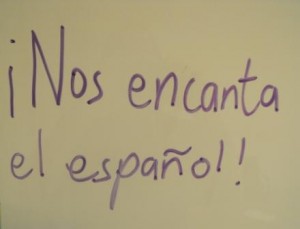 We had a large interpretation event for a group coming from all over Latin America. This brings up interest in the discussion about the varieties of Spanish.
Is a pato a duck? Or is it a Puerto Rican derogatory term for a gay man? Or is it a bedpan? In Puebla, Mexico, the word is used to mean bedpan, while in the Baja Peninsula, silleta means bedpan. No matter how you use any of these words, they give you a glimpse into the diversity that is the Spanish language.
Spanish is the native language of over 300 million people worldwide, making it the second-most widely spoken language in the world. It is the official language of twenty-one countries, and practically each one has its own version of the language.
There is US Spanish, Mexican Spanish, Latin American Spanish, Caribbean Spanish, and European Spanish. European Spanish is the most basic form of the language. Caribbean, Mexican and Latin American Spanish are essentially mixtures of the original language with indigenous words, and people often drop final S and intervocalic D in some of the countries. US Spanish is more influenced by US English, and has led to informal versions of Spanish like Spanglish and Tex-Mex.
Spanish is of course a Romance Language, meaning that it is based in Latin. Still, it has acquired words from other language groups. Arabic gave the language aceite (oil) and Frankish gave the language guante (glove). Numerous words of course entered the language from American Indian languages: huarache (slipper) and aguacate (avocado) are examples. More recently, English has contributed words like modem and Internet to Spanish.
It should come as no surprise that certain letters have different pronunciations in different countries. In Spain, LL is pronounced as L followed by Y; in Mexico it is simply pronounced as Y, and in Argentina it is pronounced ZH. Another example is the letters Z and C: Z and C preceding E or I are lisped in Spain; in other countries Z and C preceding E and I are pronounced like S (in Spanish, this is called seseo). Andalusian explorers influenced the Latin American pronunciations of the language.
Spanish, like other languages, has changed over the centuries, especially as it has travelled around the world. One of the most significant changes that the language has undergone can be seen in the use of the second-person plural. For second-person plural familiar, Spain has the word vosotros, meaning “you all”. However, outside of Spain, this conjugation only appears in common speech in Argentina, Chile, Equatorial Guinea and the Philippines. In most of the Hispanophone world, people use ustedes for second person plural, both for familiar and formal, while vosotros sometimes appears in older writings.
This begs the question: why do certain words have different meanings in different countries? It is possible that the specific mixture of people in a given region creates a new interpretation of a word. As a result, what is a neutral-sounding word in one country might be an impolite word in another country. But even without an answer, that topic is another indicator of the richness of language, and should give anyone a strong appreciation of language.
(5 votes, average: 4.20 out of 5)Loading... It is the time of the year when the Chinese people celebrate the full moon. Speaking of the full moon, it plays a major role in folk tales. It is when werewolves come to life. A werewolf is of course a human who turns into a wolf.
It is worth noting the origin of the word werewolf. The first part of the word most likely derives from Old English wer, meaning “man”, thus the word plainly means “man wolf” (or “wolf man”, to match the movie title). The translations in many other Indo-European languages agree with this root, like hombre lobo in Spanish and λυκάνθρωπος in Greek.
While most European languages are specific about the animal into which a human transforms, the Russian description of “werewolf” is more general. For example, a Russian word used for “werewolf” is оборотень, which is closer to “shape shifter”.
Shape shifter? Folk tales the world over have frequently contained shape-shifting beings. Our speculation might be that the Russians’ fear of wolves co-opted the idea of a shape-shifting being. Could the use of this word in Russian be because of the differences between Russian culture and other cultures?
By the way, according to ethologist Valerius Geist of the University of Calgary, wolves are usually not a direct danger to humans as long as they are well fed, but if they start going hungry, they can turn aggressive.
(5 votes, average: 3.80 out of 5)Loading... As a translation and desktop publishing company, we deal with words every day. Font is something that we use all the time. However, typeface is not a topic that people consider much when writing or reading. Therefore, when we heard about the book Just My Type, it was a wonderful surprise to us. Font is endearing to us and is very close to the heart of our work and daily life.
When you pick up Monterey County’s most widely read newspaper, The Herald, you cannot help but notice the two words, The Herald. The two words certainly bring out the paper’s characteristics and make it interesting and lively. But do you know which font it is? It is called Blackletter. Did you also know that it is the same font in which the title of The New York Times is written?
Among the other interesting facts about fonts:
Fonts can change the mood of a given text and dress up an idea. They can make a text look official, surreal, delightful, humorous, or romantic just as much as the actual words can. Font is part of what makes a language project appealing and fascinating. When we pay attention to it, we can bring out the language’s full possible potential. Go for it!
Interpreters play a vital role in connecting people through different languages and cultures, shaping them into one ...[read more]
On March 3rd, Monterey’s local Middlebury Institute of International Studies had its annual Translation, Interpretation, and Localization ...[read more]
Monterey Language Services will be at the annual Middlebury Institute of International Studies Translation and Localization Management ...[read more]
Introduction Our first blog of the new year includes guest writing from one of our past colleagues, who ...[read more]
Take a look at this amazing video with Disney’s impressive cast singing the localized versions of “Let ...[read more]

| M | T | W | T | F | S | S |
|---|---|---|---|---|---|---|
| « Apr | ||||||
| 1 | 2 | 3 | 4 | 5 | 6 | |
| 7 | 8 | 9 | 10 | 11 | 12 | 13 |
| 14 | 15 | 16 | 17 | 18 | 19 | 20 |
| 21 | 22 | 23 | 24 | 25 | 26 | 27 |
| 28 | 29 | 30 | ||||
