![]()


(10 votes, average: 5.00 out of 5)![]()


(12 votes, average: 5.00 out of 5)
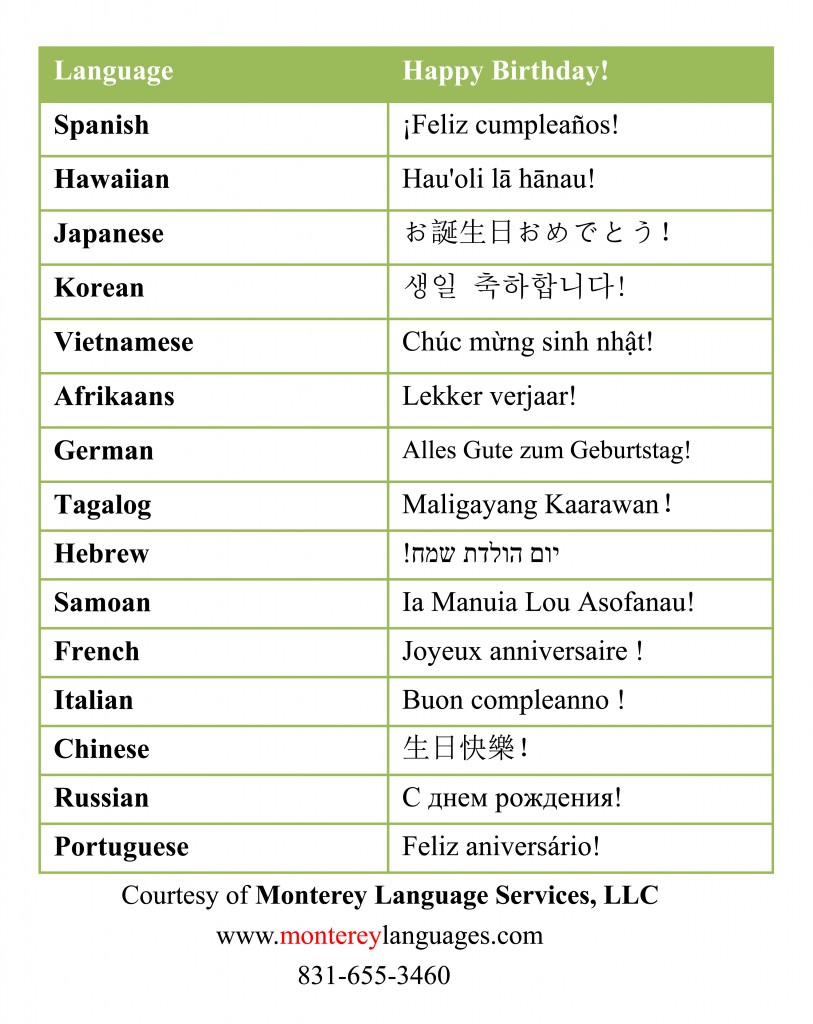
This picture posted by one of our fans on Facebook caught our eye. The Chinese characters were displayed vertically, the way they traditionally are in Chinese.
Is this a big deal? Indeed.
Our Director of Translation, Mei-Ling Chen, once made a presentation on how to handle a translation project from English to Chinese involving marketing a product to Chinese people. The all-American audience seemed uninterested until she casually mentioned that Chinese characters can be displayed vertically. All of the sudden, everyone’s ears perked up. The entire floor turned attentive…
The story reminds us once again of the need to take cultural elements into account as part of the translation process. More than just words, translation brings worlds and peoples together. Thanks to our fans for sharing the culturally revealing picture.


(15 votes, average: 5.00 out of 5).png)


(18 votes, average: 4.83 out of 5)The expression ‘lost in translation’ refers to puns or cultural references that lose their significance during translation from one language to another. The expression has been used as a title in articles, literature, television, music and movies.
Our Director of Translation, Mei-Ling Chen’s article “Lost in Translation” in the ATA Chronicle illustrates how the design element of marketing ads, catalogs, and brochures are often overlooked in foreign language translation.
In motion pictures, the Oscar winning movie ‘Lost in Translation‘ (with Bill Murray and Scarlett Johansson, directed by Sofia Coppola) vividly exemplifies the most embarrassing scenes happened in the translation/interpretation profession. The Japanese director utters several long sentences with passion, followed by brief, inadequate translations into English from the interpreter. The two central characters in the movie — Bob and Charlotte, both Americans — find themselves ‘lost’ in a culture that is foreign to them.
At Monterey Language Services, one of our missions is to promote communication beyond borders. We encourage you to share your most interesting experience which arose due to cultural differences by posting your comments here.


(15 votes, average: 4.93 out of 5)Translation is not an easy task. It requires knowledge, experience, and cultural awareness. Machines can greatly assist humans in the process of translation, but they are still far from being able to autonomously provide accurate translations that reflect cultural differences and take into account the context of a discourse. This underscores the need to ensure that only the best translators are selected for a particular assignment, based on their experience, subject expertise, and native fluency. When the selection process is not properly carried out, anything can happen. Some examples are illustrated by this lively video we found on You Tube.


(16 votes, average: 4.88 out of 5)April is National Poetry Month. At Monterey Language Services, our professional team has edited the English translation of an all time favorite Chinese poem. See our version of translation below.
Amongst the flowers I am alone with my pot of wine drinking by myself; then lifting my cup, I asked the moon to drink with me, its reflection and mine are in the wine cup, just the three of us; then I sigh… for the moon cannot drink, and my shadow goes emptily along with me never saying a word; with no other friends here, I have only them for company; in times of happiness, I too must be happy with all around me; I sit and sing and it is as if the moon accompanies me; then if I dance, it is my shadow that dances along with me; while sober, I am glad to befriend the moon and my shadow; but then when I have drunk too much, we remain apart; yet these are friends I can always count on; they are emotionless; I hope that one day we three will meet again, deep in the Milky Way.
The poet:
Li Po (701-762) was probably the greatest Chinese poets of pre-modern times. It is generally agreed that he and Tu Fu raised the poetry form to its highest level of power and expressiveness; later poets at times approached but never surpassed them.
Li Po’s distinction lies in the fact that he brought an unparalleled grace and eloquence to his treatment of the traditional themes, a flow and grandeur that lift his work far above of mere imitation of the past. Another characteristic of his poetry is the air of playfulness, hyperbole and outright fantasy that infuses much of it. –from the Columbia Book of Chinese Poetry


(16 votes, average: 4.88 out of 5)Haiku is a form of Japanese poetry. In contrast to English verse typically characterized by meter, Japanese verse counts sound units (moras), known as “on“. The word on is often translated as “syllable”, but there are subtle differences between an “on” and an English-language “syllable”. Traditional haiku consist of 17 on, in three metrical phrases of 5, 7, and 5 on respectively.
Robert Hass, a Pulitzer Prize winning American poet, reads on TV his translations of selected haiku by Kobayashi Issa. This is part of the Poetry Everywhere project airing on public television. Produced by David Grubin Productions and WGBH Boston, in association with the Poetry Foundation. Filmed at the Geraldine R. Dodge Poetry Festival. For more information, visit http://www.pbs.org/wgbh/poetryeverywhere.


(17 votes, average: 4.94 out of 5)At Monterey Language Services, we specialize in managing translation projects that involve the marketing of products and services and technical and legal communications for leading U.S. companies. With over twelve years of experience in the translation industry, we pride ourselves on our ability to apply technology to the management of foreign language translation projects.
Today, we found an interesting blog item about the concept of cloud-enabled printers that would enable any device located anyplace to print to a printer anywhere in the world:
http://www.readwriteweb.com/archives/google_wants_you_to_print_from_the_cloud.php 
This is an example of the spirit of innovation that underlies our work.
Currently, we upload files to our online system and customers need to download them in order to print. With cloud-enabled printers, however, in the future our clients will be able to save precious time by printing files directly.
Monterey Language Services will continue to monitor future trends on translation quality, translation processes, project management, multilingual technology, content management systems, e-commerce, and cloud operations. We invite you to follow us on our blog.


(2 votes, average: 5.00 out of 5)Dear Readers,
We hope you will enjoy the blog as much as we did creating it. It reflects our views and practices on translation related topics. More importantly, the blog provides an inside look at our company and the translation industry.
We invite you to post your comments and ratings. Let us know what topics are most interesting to you. Our goal is to serve you in best possible way.
If you would like to know about additions to the blog, please fill out the subscription form on the blog page. It is just one of the ways we communicate to our friends and clients.
Cheers,
Monterey Language Services Team
Interpreters play a vital role in connecting people through different languages and cultures, shaping them into one ...[read more]
On March 3rd, Monterey’s local Middlebury Institute of International Studies had its annual Translation, Interpretation, and Localization ...[read more]
Monterey Language Services will be at the annual Middlebury Institute of International Studies Translation and Localization Management ...[read more]
Introduction Our first blog of the new year includes guest writing from one of our past colleagues, who ...[read more]
Take a look at this amazing video with Disney’s impressive cast singing the localized versions of “Let ...[read more]
| M | T | W | T | F | S | S |
|---|---|---|---|---|---|---|
| « Sep | ||||||
| 1 | 2 | 3 | 4 | 5 | 6 | 7 |
| 8 | 9 | 10 | 11 | 12 | 13 | 14 |
| 15 | 16 | 17 | 18 | 19 | 20 | 21 |
| 22 | 23 | 24 | 25 | 26 | 27 | 28 |
| 29 | 30 | 31 | ||||